Maggie accepts Marco’s proposal to give their relationship a chance
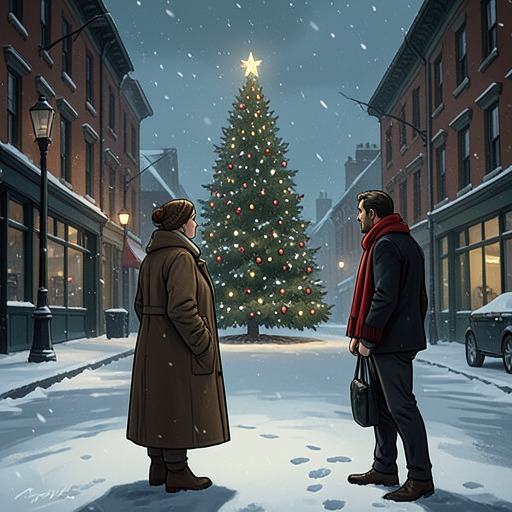
Never Kiss a Man in a Christmas JumperMaggie O’Donnell accepts Marco Cavelli’s proposal to give their relationship a chance on a snowy Christmas Eve, after he confronts her fear that infertility makes a future together impossible. The reconciliation does not promise an effortless life or settle every question about family; instead, it shifts the choice before them from an imagined perfect future to the possibility of building a real one together. Marco’s replacement of the treasured book destroyed in their first collision makes that change tangible: he has listened, remembered, and returned to the original wound with a gift that answers it.
The damaged book and the history between them
The book at the center of the reconciliation began as a Christmas present Maggie had gone to considerable trouble to find. After arriving at Kavanagh’s Books of Note, she tucked the costly brown-paper-wrapped package into her backpack and set off toward the Covered Market. Later, Marco asks whether the present she had been carrying was connected to the book she tried to gather up after their collision. Maggie explains that it was a first edition of Alice in Wonderland with Mabel Lucie Attwell’s illustrations. The crash had left it crumpled and dirty, its pages soaked with slush; although they had dried, she feared it was now only a damaged pile of paper.
The loss mattered for reasons beyond the book’s rarity. Maggie says the story had been read to her by her mother and, in turn, by Maggie to her mother. She had partly bought the volume for herself, even as she planned to give it away. With the original ruined, she considers giving cash instead and salvaging some of the illustrations to frame in the hallway. Her account reveals how the collision damaged not only a valuable object but also a gift carrying family memory. That history gives Marco’s later present its force: he remembers both what the book was and why it mattered to her.
The fear beneath Maggie’s refusal
As they sit together in the snow, Marco tells Maggie that she has built many objections around one central difficulty. He does not pretend that the difficulty is unreal or that their life together would be easy. Maggie’s infertility is a genuine concern, and she has treated it as a reason to deny the relationship before it can begin. Marco’s insistence is not that the obstacle disappears, but that it should not become the only measure of what they might share. He tells her he loves her as she is and rejects the idea that he is looking for a partner solely to have a biological child.
Maggie explains why the fear reaches beyond her own sense of loss. She remembers first seeing Marco in a park with Luca, whom she assumed was his son. After a run with Ellen, she watched Marco playing with the child and saw him as energetic, full of life, and naturally good with him. The image stayed with her; she secretly called him the Hot Papa from the Park. When Marco later appeared at the shop, she was so surprised that she could barely speak. Maggie’s affection had grown alongside an anxiety that a life without children might deprive Marco of something essential. Her hesitation therefore comes partly from what she imagines she would be taking from him, not only from what she fears she cannot offer.
A future defined by choice, not by an ideal
Marco answers Maggie’s concern with possibilities rather than a demand that she change. He says they could consider adoption, share time with Luca and Rob Jnr, or simply be together. He recalls having once said that finding the right woman mattered most, and now identifies Maggie as that person. In his view, a future with her is more important than an idealized future with someone else. The scene’s contrast is deliberate: Maggie sees children as a vital part of the life Marco deserves, while Marco sees their relationship itself as the foundation from which they could make a life, with or without children.
The imagined future becomes more specific as he offers Maggie room to choose its pace and shape. They could move slowly or quickly, stay where they are or live in Chicago, and even marry; he adds that he cannot promise perfection or make a conventional proposal on one knee at that moment. He is not presenting these options as settled plans. Rather, their range counters Maggie’s belief that one painful fact has already decided their ending. His appeal is for her to take a risk on the relationship, without pretending that the questions ahead have simple answers.
The gift and Maggie’s answer
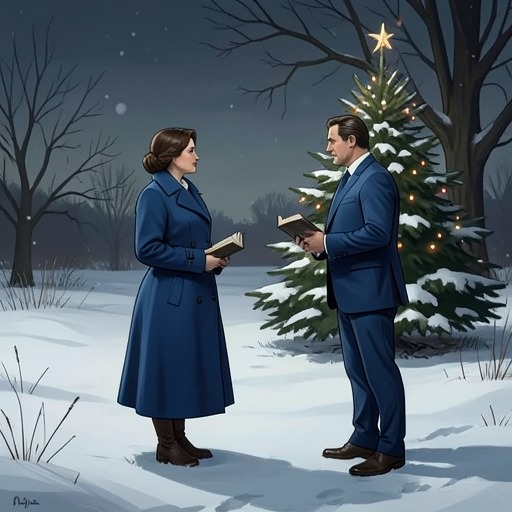
Marco then gives Maggie a wrapped parcel. Inside is another first edition of Maggie’s Mabel Lucie Attwell-illustrated Alice in Wonderland, matching the book he destroyed when their bicycles collided. The replacement shows that he has held on to a detail she might have assumed he could not remember: she was protecting a book with personal and family meaning, not merely trying to save an expensive purchase. Where the first volume was soaked and crumpled in the accident, this one arrives intact, placed in her hands as evidence of attention and care.
Maggie calls the gift perfect and kisses him. The kiss is cold and barely felt, yet it releases the tears she had been holding back. She worries that she has brought him no present in return. Marco does not ask for one; he asks her to give their relationship a chance. He connects that request to the roles both have long occupied, with Maggie living for Ellen and her father, and Marco living for Rob through difficult days. The moment reframes acceptance not as a debt owed for the book, but as a decision to stop postponing their own lives for other people.
Maggie carefully wraps the book again to protect it from the falling snow. As distant church bells mark midnight, she looks at Marco, bruised and battered but still resolute, and answers yes. The word establishes a beginning rather than a completed future: she agrees to take the risk, not to a guaranteed outcome. The replacement book repairs no accident literally, and her infertility remains real, but the gift and her answer together reverse the scene’s governing expectation. What had seemed to Maggie like an irreparable loss becomes the ground on which the two of them can choose to begin.